
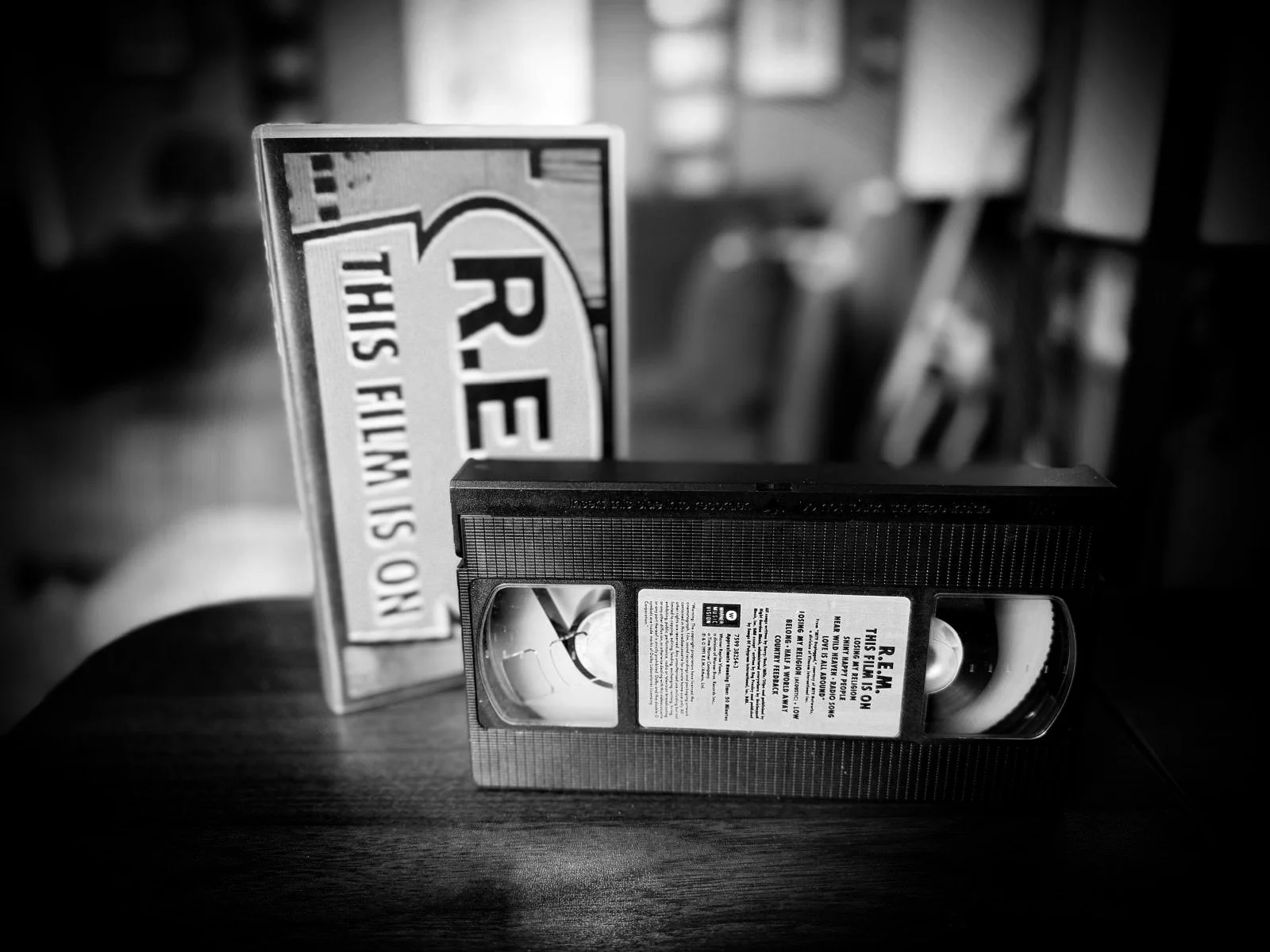
This Film Is On:
On My Friend, Who Is Now Buried in the Ground
by Fran Mulhern (Non-Fiction)
[From the Editors - why we love this: the idea of the path not taken is well trodden as writing material, but Mulhern’s piece goes further and looks at death, regret, how we move on with our lives and the lingering romantic suspicions which surely can’t be his alone.]
It was after midnight when I had the idea. Search the cemetery burial records to find out when Brian died. Strange, I thought, how this hadn’t occurred to me in the years since I’d heard of his death. I can be like that sometimes: I’ve been aware for years that I’m nowhere near as clever as they think I am. I always miss the obvious., often seeing only the trees on the first few passes. But I’d spent so long wondering when exactly he died and it had never occurred to me to check the records. And there it was, in blue and white on my screen.
Brian S. Age, 26. Date of death, 30 November 2003. Buried just over a week later, in Belfast City Cemetery.
There was a reference to where he was buried – plot Q1 – and it took me a while to track down an online map. Eventually I realised he was buried just behind the Keeper’s House by the Falls Road entrance. They sell flowers there, at the Keeper’s House, and I wondered how many of them had been bought over the years for Brian. I used to play in that graveyard as a child, back during the Troubles and before we moved away from the estate onto which it backed. I thought about my own parents and brothers, dead in the same earth at the other end of the cemetery. Mum, Dad. Joseph, Liam. All up at the top, while Brian was down near the bottom. But finally, after years of wondering when it happened, I had the actual date of death of a man I’ve spent so many of my adult years wondering if I was in love with.
I can’t remember when I first met him. I was, what, sixteen? Maybe seventeen? We went to different schools. Brian’s grammar school sat directly across the road from my comprehensive, although it may as well have existed in another country. His school had a swimming pool and grass football pitches. We had a gravel field that shredded your knees if you fell badly enough, and you often fell badly enough. Their students were destined for university – ours, for factories or unemployment.
We met through mutual friends at a Christian youth meeting called Youth Initiatives. Everybody called it the Group, as if giving a name to it somehow added weight or gravitas. Your standard evangelical Christian youth group – platitudes, acoustic guitars, lots of moral superiority. Happy clappy. Cliques. You either were in or you weren’t. Funny how cliques dominate religious groups. I suppose that’s the nature of any group that sees itself as superior: it closes inward, jealously guarding its sense of superiority. The Group had maybe a hundred members and there was a leadership group of ten or so, made up of adults and the older kids they presumably saw as future leaders. In years to come it would be rocked by allegations of sexual misconduct, but that’s a story for another time.
Brian wasn’t very religious. In fact, he wasn’t religious at all: I think he only ever went there for something to do on a Wednesday night. I was a bit more into it – my own mother had died a few years before I first went, and a strained family life meant the youth group gave me a ready made alternative family I could rely on (so I thought) for support. I was never part of the in crowd though – I always existed very much on the outside, circling around like a fish and looking for ways to be part of that inner circle. It never really happened, and in the end I was glad of that.
Over the next couple of years we spent a lot of time together, as part of a larger circle of friends. Brian was always popular: good-looking and smart, he had that easy way with people that often comes from the confidence of knowing oneself. He didn’t care what others thought of him because if they had a problem then it was theirs to deal with. I wish I could give a defining physical feature – that he was particularly tall or short, fat or thin. He wasn’t – he was just plain average. Had light brown hair he wore in a middle parting. Probably because he was at a grammar school, I think he fancied himself as a bit of a philosopher. He liked Camus, and when we’d discuss things and I’d ask why he’d always come back to, Oh that’s an intrinsic belief as if that was the end of the argument. He’d say it with such conviction that you’d just shut up and accept it.
He was big on REM, which is funny because until I met him I absolutely hated REM. Can’t remember why. But this was back during their Green and Out of Time era, and through him I became a fan. We’d spend afternoons in his living room watching This Film Is On on VHS, a collection of REM songs from the two albums. He’d talk with such passion about the lyrics, and that passion would sweep you up. I’d sit and listen to him, or watch him talking with others, and wonder if I was in love. This was Ireland, mid-90s - back then it took a much braver person than me to admit to such feelings.
I doubt I was his, but for a few years he became my best friend. In 1993 my brother Joseph was killed by the IRA. A member of that organisation, he’d been blackmailed by the security forces into turning informer: if he didn’t, they told him, they’d have our father shot by Loyalist paramilitaries. We didn’t know this at the time, mind. In the days that followed, though, I kept listening out for the phone to ring, for someone from the youth group to say, Hey, that’s terrible, we’re here for you. Nobody did though. Brian and his older brother - who by this point really hated the group - were the only friends who called me or joined me at his funeral. After the years of these Christians preaching love and friendship and all that other bollocks, not a single one of them called or turned up to pay their respects. If I’m being charitable I can understand it – being labelled an informer, or even the relative of one, carries a stigma in Ireland and they probably just didn’t want to be associated with me for fear of what others would say. Forgive and forget is easier on paper, though, and being charitable is a prerogative I can take or leave.
After Joseph’s death I went back to school. In the year leading up to his death I’d been drifting, not really doing much with myself. His shooting made me realise that I needed to get out of Belfast, and sitting my A-Levels and going to university was the best way of doing it. This was back when university was free. I enrolled at a further education college in the centre of the city. The Belfast Institute of Further and Higher Education is long gone, though the building is still there. It’s student accommodation now, and sometimes I see pictures of the inside of the building and wonder if its current occupants ever think about those who went before.
Slowly, almost imperceptibly, Brian and I drifted apart. It wasn’t anything intentional – it’s just what happens. We made different friends and saw each other less ad less. My own family moved away and I stopped going to the Group as much, so I also stopped hanging around with other friends who knew him. I can’t recall the last time I saw him, which is sad. Sometimes we miss those moments, not realising just how significant they can be.
In September 1995 my dad dropped me off at a side road near Belfast City airport. I’d gotten AAB in my A-Levels – a far cry from my awful results before (six Cs at GCSE, after two attempts) – and was going to England to study law. I told myself I’d never return.
‘Parking in there’s a nightmare,’ Dad said to me as he pulled up, though when I look back now I can see that he was upset at the thought of me leaving. It can’t have been easy for him – a dead wife (1985), a dead son (1993) and a daughter in America who wanted nothing to do with him – and there he was saying goodbye to another child. He took my rucksack from the boot of the car (no wheeled suitcases in those days) and we shook hands and said our goodbyes. He turned, got into the car and drove off, and I made the last hundred yards journey to the airport on foot. I was too excited to notice his lingering before he got into the car.
The flight was going to take me to London, then my plan was to catch a coach to Norwich, then a taxi to campus. At security I met a girl booked onto the same flight. We talked and she said she was off to study Chemistry at King’s, but that’s where the conversation ended.
I carried with me a portable CD player and as the plane rose into the air Half A World Away by REM was playing on my headphones.
This could be the saddest dusk I've ever seen.
I turn to a miracle, high-alive.
My mind is racing as it always will,
My hands tired, my heart aches.
I'm half a world away.
Mad, I thought to myself. This song playing, and me, sitting here now, taking off. England might as well have been half a world away.
I hated university. I was unprepared for it and England felt not so much like a foreign country as a whole other galaxy. I was carrying all this trauma from growing up in Belfast. Dead mother, dead brother. All the experiences of the Troubles. Army raids in the middle of the night. Kneecappings. Rioting. People being shot for no reason other than their religion. It was naive to think I could even seamlessly slot into life in England amongst, mostly, middle class students: but then what’s our youth for if not naivety?
Over the next ten years or so I moved around a lot. Graduated – though not without incident - and went to law school in Chester. Moved to Reading and qualified as a solicitor. Lived in Bolton for a while, then Tunbridge Wells. If you’d have plotted my movements on a map it would have looked like a ping pong ball shooting all over the country. I was running, though. I don’t think I realised it at the time but looking back now it’s as clear as day. I was running from Belfast, from the Troubles, from Joe’s death. I was running from Dad – nice enough on his day but an abusive father who wasn’t shy about using his fists.
When I was living in Reading I’d go into London most weekends. Reading was only twenty minutes from the capital, so it was easy to go there for the day. One evening while coming up the elevator at Charing Cross underground station I heard this strong Belfast accent.
‘Frankie!’ he shouted. ‘Frankie!’
I looked up and coming down the escalator in the opposite direction was someone I’d known from the Group. I said hello, and when I got to the top I went back down the escalator to greet him properly. We exchanged a few words, but the truth is I was desperate to get out of there and was just being polite. Absolutely nothing to do with him, but I wanted nothing to do with Belfast, with back home. There were too many memories I’d spent too long trying to block out. We said we’d keep in touch and we may even have exchanged numbers – I don’t remember the detail. We went our separate ways though, and on leaving the station I disappeared into the night and forgot all about him.
Law didn’t work out. I qualified as a corporate lawyer but never really fitted in, the same way I’d not fitted in at university. Back then I blamed it on me, on my inability to assimilate into a sea of lawyers and bankers who’d never had to put up with bombs and bullets, with abusive fathers and mothers dying young and brothers being abducted and killed. I’m kinder to myself now. To have gotten as far as I did, without any connections and with all the trauma – that was perseverance and an achievement in itself. Back then, though, I tortured myself about it. If I drink I still do, which is why I’ve not touched the stuff in almost three years.
And back to Brian. Sometime in the late 2000s I started reconnecting with people from Belfast on Facebook. People I’d known at the Group. I looked for Brian but couldn’t find him. I always asked but nobody knew what had happened to him – until someone did.
‘Yeah,’ they said, ‘he died a couple of years ago. Was visiting home and his mum just found him dead in his bed one morning.’
I asked what caused it.
‘They don’t know. Adult sudden death syndrome, I think they call it. Some people just die.’ Then the conversation turned to something completely different, like Brian’s death didn’t matter.
I asked around. Nobody could really say any more – at some point I suppose they’d also grown apart from Brian and so he’d become just somebody they used to know. Strange how that happens. You hear on the grapevine – such and such happened to so and so, and oh isn’t that sad? And by the way, what’s for dinner?
But until the other day I’d never found out exactly when he died. For years he occupied this strange place in my brain - I knew he was dead but that was it, nothing about when. It was like some kind of partial fact about a far away land, I suppose.
And then one night it dawned on me to look at City Cemetery’s records and there he was. I know exactly where his grave is, and he’s been there 23 years this December. It’s mad. I think of all the things I’ve done in my life. While I was nearly getting married in South Africa, got married in Canada, got divorced in London, got married again in Wales, all the other stuff - Brian was lying in the ground a couple of hundred meters from where I grew up and where Seamus Heaney taught at St Thomas’s before he became famous.
And so that’s Brian. I still can’t work out if I was in love with him back then - he was the first boy (and that’s all we were back then, boys) I felt that about. I probably was. I must have been, to some degree.
Sudden Adult Death syndrome. Life can be so unfair and he deserved better. But it is what it is and we move on, because what else can we do?
About the Author
Fran Mulhern is an Irish writer originally from Belfast and currently living in England. His work has appeared in The London Magazine, Litro, The Honest Ulsterman, A New Ulster and elsewhere. Despite being 51, he still hasn’t quite worked out what he’s doing with his life.