
Northern Charm
Emma Taylor (Fiction)
When Matthew received the call that his dad had died, he was still wet from the ocean. Sand in his fingernails, saltwater stinging his lips.
Matthew’s mum, Liz, her voice thick with a Yorkshire accent, told him there was no point in rushing home. She knew Australia was far away, and when he was done gallivanting around the world, he could come home and say his proper goodbyes.
This news didn’t surprise Matthew. He’d almost expected it. A man in his seventies, still herding sheep, still milking cows, still drinking ale like it was healthier than water and smoking his pipe stuffed with tobacco, wasn’t going to live long.
His mum, though a tough woman, had never driven a car. She could survive without electricity, could cook a roast from scratch, but she was old-fashioned, just like his dad, and believed in a strict division of labour. Cars didn’t interest her, and it was a gruelling twenty-four-hour plane journey followed by two trains and a bus he had to wait thirty minutes for.
As Matthew sat in the freezing station, rain battering the glass ceiling, smelling of recycled air blended with his own body odour, he longed for bare feet. For sun against his face.
The bus arrived eventually. He almost vomited as it roared down the narrow roads, flanked by dry stone walls. Potholes brimming with rainwater, sharp bends that the bus driver took no mercy with.
When he arrived in the village, night was settling in, and the streetlight cast a dim glow over his childhood home. He almost laughed at the stone cottage. In Australia, he lived in a city with eucalyptus trees lining spacious roads, in a red-bricked house built in the sixties. But his childhood home was tiny: crammed rooms with low beams, exposed stone walls, mismatched furniture, and his mother in her armchair, the fire crackling beside her.
Apart from his dad’s empty seat, nothing had changed.
Liz didn’t look up from her sketchpad as he said hello. ‘How are you, son?’
‘Tired.’
She dropped her pencil, her grey-blue eyes taking their time to inspect her only child. ‘What’s with the accent?’
She’d aged, her hair now a blanket of silver, and skin like crinkled paper.
‘Why are you so dark? You’d think you were Spanish or Moroccan.’
‘Australia, it's a hot country.’
She picked her pencil and returned to her sketchpad. ‘Shall I make you some tea? Plane food is a bit shit, isn’t it?’
‘Coffee would be great.’
The pencil fell from her hand. She glared at her son. ‘Coffee?’
‘Tea is fine.’
Liz nodded. She disappeared into the kitchen. Matthew studied her from the open door, floating effortlessly around a room she’d spent most of her life in. A twinge tugged at his stomach. There’s so much more than this, he thought. So much more than a lonely village in the middle of the lonely dales.
On the fridge, hanging at a slant, were postcards from his travels: city lights blinking under dark blue skies, beaches, sunsets, sailing Sydney Harbour. Matthew wanted to cry.
The next morning he woke to sunshine in his bedroom. It wasn’t a hot, raging sun; it was a weak sun that carried a breeze. A rooster crowed in the distance, and the scent of chimneys and cow manure lingered in the room. He had slept, though for how long he wasn’t sure, and he struggled on the stairs, vertigo throwing his body from side to side.
Liz was still by the fire, still sketching, though he noticed she’d changed her clothes.
‘Sleep well?’ she asked, refusing to look at him.
Matthew nodded.
‘You’ll need to see your father today. He’ll be expecting you. He’s buried in the churchyard next to his parents. I guess that’s where I’ll be buried. And you, if you choose.’
Matthew scratched his neck. ‘What are you drawing?’
‘Jonathan Pope from no. 33 is writing a book about local tales of this area. The ghost of Mrs Moorly, the fairies that live in the woods, and of course our own witch who curses the hill. Asked me to do the illustrations.’
Matthew tried not to react, tried to keep his eyes still, his lips smile rather than curl. Another reason why he loved life on the other side of the world: freedom from the silly superstitions that hung around this village like drizzle on damp, cold mornings. Goblins, werewolves. Every house is haunted. You can’t step on three drains. Don’t count the magpies.
It was midday when Matthew approached the church. As soon as he opened the gate, its golden bells, high in the tower, sprang into action. Historians had tried to date the church; the only conclusion they had come up with was that it was ancient. Once part of an abbey before the Dissolution of the Monasteries, but somehow the church remained. It had survived plagues, war, death, invasion, but its walls, its stained-glass windows refused to crumble.
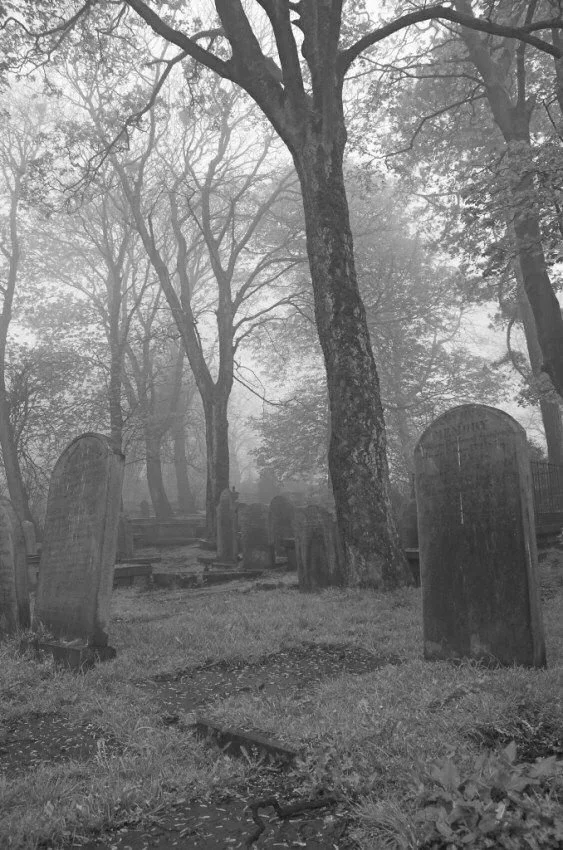
He followed the rows of gravestones, each one with its own character: some shaped like crosses, one shaped as an angel, and others curved at the top. Some covered in moss and some with cracks like tangled ivy running down them. Graves from different centuries. Families with unusual names, and names that were like the church that would never disappear. And finally, modern graves: smaller, tidier, with fresh flowers at their base. And his father's grave. Beloved husband, father. Carer of sheep and cows. A true Yorkshireman.
Matthew sat down on the dewy grass, facing his father’s headstone. In the distance, there was a rumble of vehicles and the slow amble of a tractor. He tried to cry, but it wasn’t sadness he felt; it was peace.
‘I will miss you, Dad. I am sorry I wasn’t here at the end.’
With the autumn sun against his face and the soft breeze scented with wildflowers ruffling his hair, Matthew closed his eyes. For a moment, he tumbled into darkness until a crow cawed.
Matthew lurched backwards, his eyes flying open, paralysing his body.
She had a white face as though smothered in talcum powder. She was wearing a long black dress, like a Victorian widow. A bonnet perched on her head. From behind an old grave, she stared at him. Matthew’s breath stuttered. He tried to say something. He tried to move.
His phone rang, shimmying in his coat pocket. He reached for it. Hands trembling. He glanced at the flash of his mother's number, and then slowly back at the graves.
She was gone.
The Old Duke pub was the highlight of the village Matthew had grown up in. Just like his childhood home, it had low ceilings, fires in each of its rooms. It also had an overstocked bar with brass pumps gleaming under the low light and was scented with crisps and spilled lager. The drinks promoted the area: Cowpat Ale, Lamb's Lunch Beer. Of course, superstition was in there: Witch Potion Gin, Mrs Moorley on tap.
‘I will take a pint of Fosters,’ Matthew grunted.
He took a seat on a creaky stool by a sash window. Hallucinations. Tiredness. A figment of his imagination brought on by his father's death and his dramatic return. As he tried to reason with what had just happened, Matthew felt her again. He took a breath and, with a slow exhale, turned to the window. She was standing by the gate of the graveyard. Her ice-white face glaring at him.
A noise escaped his lips, growing louder as a hand hit his back.
‘Sorry, Matty. Didn’t mean to scare you. You’ve come back to us.’ It was Greg, a friend from primary school. He looked almost identical to the last time Matthew had seen him. Still wearing his navy-blue quilted jacket and matching flat cap, still bristly across the chin and jawline.
‘Can I get you another drink? You look like you’ve seen a ghost.’
Matthew nodded. ‘I think I have.’
‘Aww mate, I might not be as tanned as you, but I am not that pale.’
Matthew laughed, shrieks stumbling from his lips. And Greg laughed with him. The afternoon in the pub turned into endless laughter. Greg impersonated their old teachers, told Matthew stories about working with his father in the fields. They played darts. Greg won. They played pool. Greg won again. They devoured packets of crisps and discussed music and sport. Matthew tried to sell Australia, but it was too far for Greg to visit, and he liked the cold.
Daylight escaped them, and it wasn’t until Matthew glanced at the clock that he knew it was time to leave.
‘Not yet,’ Greg protested.
Matthew staggered from his seat, his hand reaching for the wall. ‘Another time.’
It was a cloudless night, the sky dusted with stars. Matthew mumbled a tune as he wandered the quiet roads. It was only when he passed a row of cottages with slate roofs glinting in the evening light that he realised someone was whistling along with him. He paused. A crunch of footsteps. The hiss of his name.
With his lungs sucking in as much air as they could, he turned to see her.
The lady in black. The outline of her dress. The white of her face. A stone's throw away from him. Matthew’s heart hammered his chest. And he ran. Fast.
By the time he got home, he was so out of breath he could barely talk.
‘What’s wrong with you?’ Liz said. She was in her usual spot by the fire. Sketchpad in her hands. ‘Let me get you a tea?’
Matthew collapsed onto the sofa, his breath softening as he gazed at the flames in the fire. His eyes moved to his mother’s armchair; her body had left an imprint in the fabric. He shifted closer and studied her drawings, the sketches of fairies with patterned wings and long, unruly hair hiding in the trunks of trees. She was talented, but Matthew had always known that. He turned the page. A gasp tumbled from his mouth. He stood up. Swear words rolling off his tongue.
‘What’s the matter?’ His mum appeared in the doorway.
Matthew pointed at her drawing. At the lady in the black dress with her bonnet and ice-cold face.
‘That’s Mrs Moorly’s aunt. Elizabeth Beckwith. She was a wicked woman.’ Liz stared at her son. ‘You haven’t seen her, have you?’
To say, Yes, I have. Three times, Matthew had to close his eyes. Had to ram them tightly shut and ignore his thoughts screaming at the madness.
‘Well, that’s not good. Not good at all.’
They sat by the fire, orange and golden flames hissing and curling, mugs of tea warming their hands. His mum told him all about Elizabeth Beckwith. A bitter widow from the turn of the century, devoted to this village and these dales. A woman known to bring bad luck, appearing if she felt there was a sense of abandonment. Or just plain selfishness.
‘Perhaps don’t do anything silly like jump out of a plane. Or get on a plane.’
Matthew stared at his mum. There was something unusual about her lips, pressed too tightly together, curving at the edges.
‘And if I do?’
She shrugged. ‘You remember Georgina Harrington from no. 43? Her daughter started seeing the ghost of Elizabeth Beckwith just before she went to university. Let’s just say she didn’t last long.’
Two weeks tiptoed by without a sighting of the lady dressed in black. Matthew reluctantly changed his flight, and he spent his mornings in the garden with his mum, rearranging the vegetable patch, and his afternoons sorting through his father’s clothes. Most were being shipped to charity shops, but those few items where his scent still lingered, where in the pockets Matthew discovered wrappers of his favourite sweets, tobacco pouches and old coins, they kept. On evenings, he’d hang out with Greg. They’d play darts and pool at The Old Duke, Matthew accepting continuous defeats.
One unusually hot afternoon he visited Greg’s family farm, his eyes lighting up when his sister appeared in the hallway. Matthew couldn’t remember her from school; too young. But she was older now, with soft blonde curls. She smiled as much as Greg, and as they shared homemade cider, a chorus of laughter bounced around the farmhouse.
It was on that day that Matthew realised he hadn’t thought of Australia or South East Asia, of India or Singapore. He hadn’t woken to the longing of an ocean, to the scent of coconut lotion and exotic fruit, to a burning sun against his skin.
He wandered home that night, a spring in his step, humming more familiar tunes, and he thought that this village in the middle of what felt like nowhere, haunted by almost everything, wasn’t really that bad at all.
To his surprise, his mum was in bed when he returned home, just a few embers on the fire. He sat down in her armchair, imagined himself sketching with Greg’s sister by his side. He was laughing again, but it felt odd laughing alone. He closed his eyes. The air moved slowly around him, and he mumbled a song from school. You’ve got the whole world in your hands.
Matthew heard it repeated outside, but it was a feminine voice, angelic almost. A haunting echo of something he’d sung in the school hall, in assemblies. Occasionally in the pub after too many beers.
He’s got the whole world in his hands. Matthew’s got the whole world in his hands.
He opened his eyes. The voice grew louder, higher. Almost a scream.
He knew it was her, Elizabeth Beckwith. Maybe it was the cider, or maybe he’d just had enough, but he hurled himself towards the window. Her figure by the garden gate, her eyes glaring at him.
‘Go away!’ he screamed. His hands battered the glass pane.
But she just stared at him.
Matthew fell to the floor. And for the first time since he arrived home, he wanted his dad.
The next day, sombre and tired, Matthew sat by his bedroom window. The postman on his bike, the vicar and his assistant, carrying flowers into the church, schoolchildren dressed in navy and grey holding their mother’s hand. A dog walker, a group of walkers, a solo walker. This had been his life for eighteen years, yet it felt like some distant part of him. But today, so did Australia. He looked at his phone and the stream of photos in his gallery. So many beaches, so much greenery and golden sun. It almost bored him to look at.
His finger hovered over the Google icon. He clicked on it.
Ghost of Elizabeth Beckwith.
He couldn’t find anything on her, but there was plenty on the ghost of Mrs Moorly and all the other ghosts that roamed this village.
Matthew sighed.
A message from Greg flashed across his screen. Fancy lunch at The Old Duke?
When he arrived at The Old Duke, Greg was at the bar scrutinising the menu.
‘How are we, Matty?’ His face broke into a dazzling smile.
Greg’s smile was infectious, and for no apparent reason, they laughed.
Matthew placed his hands in his pockets, his laughter fading. ‘Shit, I forgot my wallet. I’ll be back.’
Greg grabbed him. ‘I’ll get lunch.’
‘Don’t be silly; I owe you and it’ll take me two minutes.’
‘Please don’t go.’
‘Seriously, mate, I’ll nip home now. Lunch will be on me.’
When he arrived at the cottage, he realised the front door was open. Matthew always closed doors behind him, a habit instilled in him by his father. And as he stepped forward, he noticed his hands shaking.
He considered calling his mother's name, but the low hum of her voice filtered through the house. So did another voice. He scratched his head, thought about leaving, letting Greg wine and dine him.
He decided against it. He moved into the empty living room, the fireplace silent and bare. With his feet quiet against the stone floor, he pushed open the kitchen door.
She was there.
The lady in the black dress with the bonnet, but today, not a pale face. A youthful, healthy face, gleaming with colour. Elizabeth Beckwith. Her chest moved up and down, words stumbling out of her mouth.
She stood up. Apologised.
Matthew stared at her. Then at his mum, Liz, who was now standing, her head shaking.
Elizabeth Beckwith excused herself, glancing at Liz as she hurried outside.
Minutes trickled by as Matthew and his mum stared at each other.
‘Tea?’ she finally asked. ‘Or would you prefer a coffee?’
Matthew looked around the kitchen: two mugs on the table, his mother's boots by the back door, the oven light switched on, fresh pencils on the table. ‘She’s not a ghost, then? She’s not bringing me bad luck?’
‘No, son.’ Liz fiddled with her wedding ring. ‘She’s Derek from no. 63’s daughter. Training to be an actress. I, well, paid her to haunt you.’
Dumbfounded, utter shock racing through his body, he finally asked why.
‘I don’t want you to leave. Want you to stay in Yorkshire. Where you belong, son.’
‘You could’ve just asked.’
His mum nodded. ‘Suppose I could. Not sure it would’ve worked. Sure I can’t make you a tea?’
Matthew’s eyes narrowed. He thought about returning to Greg. Ordering Mrs Moorly on tap while they laughed at the madness. Instead, he moved closer to the table. He pressed his fists against the wood, his knuckles glowing white, and he studied his mother. Her hands clasped together, her lower lip quivering.
‘Your full name’s Elizabeth.’
She nodded.
‘What’s your maiden name again?’
She opened her mouth and allowed silence to hang in the air.
‘Beckwith. I never intend on leaving this place, son. Even in death. Don’t really want anyone else leaving. Especially not my Matthew.’
About the Author
Emma was born and raised in North Yorkshire and now lives in New Zealand, though returning home remains a regular pilgrimage. She has an interest in the paranormal, which finds its way into her work. Emma won the New Zealand Writers College Creative Writer of the year award in 2025.