
Green Hills and White Smoke
Sarah Galaro (Non-fiction)
The green Tuscan hills do not prepare me for the jarring clatter and roar that fills the Uffizi Gallery in Florence. In the Hall of Statues, a first-century bust of the emperor Antoninus Pius stares down at me. His face is just one of many in the bustling corridor—a field of faces, stone and flesh, jostling each other like the poppies on crowded hillsides that line the highway.
I arrive at the cavernous stone colonnade outside the Uffizi with my friend, Sam. Along with our husbands, Sam and I wait for our pre-booked admission time. The kind of friend who makes reservations for the group and prints them out, Sam passes folded papers with QR codes to each of us. Languages and cultural expectations mingle in the growing crowd. An attendant snaps at me for standing in the wrong spot, and although my inner nonconformist wants to challenge her, I graciously comply instead. Around Sam, I’m always just a little more generous, a little more humble. Everyone says it: Sam is a class act.
Under the stony gaze of Emperor Antoninus Pius, patrons line up with those who share their language and a connected Bluetooth channel. Ants with tiny ear buds carving their way, single file, through packed corridors. The microcosm of humanity in the museum is not so much a melting pot as a mixed salad—bits and pieces tossed together unceremoniously, analogous ingredients clinging to one another in the bowl. It feels like everyone is visiting Italy right now, and that’s not far from the truth.
Days before our arrival, Pope Francis was laid to rest. We had already booked flights on an off-day to avoid crowds from the 2025 Jubilee, the special year of Catholic celebration, this year dubbed The Year of Hope. Now, in addition to the throngs of Jubilee tourists and pilgrims, our trip coincides with the selection of the new pope.
Sam buried her mom on Wednesday. A terrific thunderstorm followed me for the three hours it took to drive from Dallas to Oklahoma City for the memorial service. Texas-sized rainclouds dimmed the scenery, and massive raindrops crashed into my windshield in never-ending percussion. I switched on my hazard lights and turned my audiobook to maximum volume.
I never knew Sam’s mother, at least not in the way Sam and her father remembered her. But as they spoke at the simple memorial service in their local Baptist church, I was struck by how familiar she felt to me. I listened to family and friends tell stories of her hospitality, intellect, and dignity. I imagined myself a time traveler years in the future; I could hear those same words spoken about Sam. I’d known my friend for nearly a decade, but never more intimately than at her mother’s funeral.
Over potluck casseroles in the carpeted parish hall, Sam’s relatives greeted me. “Oh, you’re the one going to Italy with Sam! How special,” they smiled. “Make sure you visit museums. See art. And flowers.” I sensed that my presence and the upcoming trip were a welcome opportunity for everyone to smile. “Her mother would have loved that.”
Driving through Tuscany a week later, the most rain we get is a light mist. More often than not, the sun breaks through the clouds, blessing us with bright light and blue skies. Unlike quintessential summers in Tuscany, we do not see sunflowers. In early spring, the hillsides are riddled with garish red poppies instead. Throughout our weeklong stay, they grew more and more ubiquitous, slowly taking over the roadsides and popping up along green ridges like children clambering for a view of a rental car zooming down the highway.
From the backseat, Sam shares a little of the past few weeks—selecting the coffin, notifying old family friends, choosing colors for the florist. Trying to capture the person her mom was, trying to celebrate, trying to mourn. Sam is always pensive, and now she is more reserved than usual. But she is glad to be on this trip, glad to take time away somewhere beautiful. Like letting go of a long-held breath. I watch her closely.
In the Uffizi, I find myself watching everyone else. Not looking at art, but the art of looking at people looking at art. It’s delightful, but cognitively dissonant, that in our era of generative AI and commoditized creativity, a place like this is packed. Does that represent hope for humanity, or signal a depressing lack of self-awareness?
I sense the overwhelm of many of my fellow patrons, like kids at the grown-up table. In their faces, there’s a vague recognition that art is culture, and looking at it might make them cultured, or affirm their culture. But when sharing the same air as Leonardo da Vinci’s unfinished painting, Adoration of the Magi, approaching its vulnerable inkstrokes and yellowed waterstains, all tender glory and light, they seem awkward, like they’ve forgotten how to look, a sense that they’ve used intuitively since birth.
Confronted with beauty too vast to absorb, we retreat into something smaller: ourselves. Is this a uniquely American sin? Observing the international patrons around me, I doubt it. In a side gallery, teenagers turn their backs to the art and snap photos out the window: red clay roofs, green hills beyond, gray clouds, sunlight bleeding through. A baby’s cry spirals upward from the stairwell, raw and tender.
I step close to a painting depicting the Madonna and child, nose near to the pockets of paint that rise from the canvas. How else am I to see her and know her, that rosy-cheeked Mary looking down on her baby? It strikes me that when it comes to perception, quantity is inversely related to our sense of humanity. When we fail to grasp the magnitude of mass tragedy, the story of one person pierces our hearts. It’s the same with these paintings, I realize. We don’t get the grandeur until we step closer.
The next day, we break the cardinal rule of the well-itineraried traveler; we take a day off. I WhatsApp-message our pre-booked wine tour and cancel. Sam and her husband leave the house early and return with fresh croissants and jam. The bits of orange rind in the jam are chewy and sour, a bitter and bright wake-me-up as effective as espresso. We gather around the coffee table in our rental home and played dominoes. I still don’t understand the rules, and Sam is too good a player to have her own hand anyway. Instead, she positions her head over my shoulder and helps me play, guiding my strategy. I listen.
The clouds grow fat and gloomy, and we drive to the Hermitage Le Celle, a secluded monastery founded by St. Francis of Assisi in the early thirteenth century. With the looming rain, we are nearly alone in the place. We wander the grounds in silent mist. A weeping willow bends over a soft waterfall. Brown stone buildings peek from behind wild rosemary bushes, nestled into the contours of the mossy mountainside. I receive a smile from a gentle-faced monk as he strolls over a bridge, hands clasped behind his back. We are invited into his sanctuary, welcomed to sacred ground. I smile back and hope I am a gracious guest. I drop a few euros into the donation box and pocket a laminated Franciscan prayer card.
O divine Master, grant that I may not so much
seek to be consoled as to console;
to be understood as to understand;
to be loved as to love. For it is in giving that we receive;
it is in pardoning that we are pardoned;
and it is in dying that we are born to eternal life.
A gray van pulls into the parking lot. Instead of a tour group, a dozen nuns emerge. Women of various ages clad in brown vestments and Teva sandals chatter to each other. “Do convents have field trips?” I wonder. Suddenly, church bells begin to peal. The nuns hug each other and jump up and down, giddy. One of them squeals with joy like a toddler.
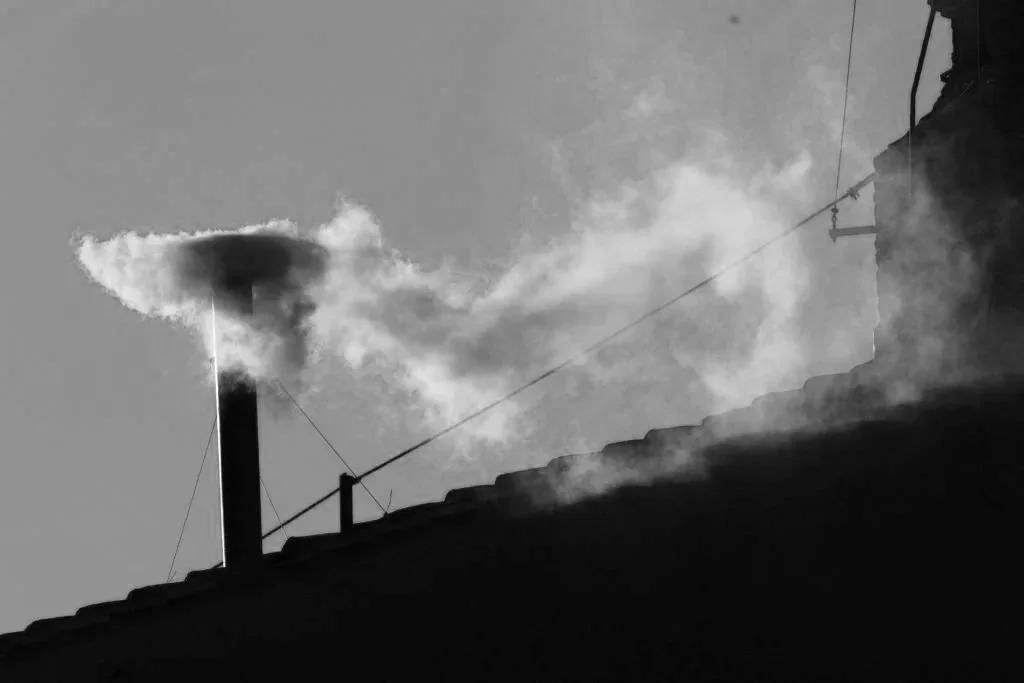
After an unprecedented two-day conclave, the new pope is selected. White smoke pours from the chimney at St. Peter's Basilica in Rome, just south of us. Rolling over the rooftop like fog, its form signaling the mouthpiece of the divine. None of us is Catholic, yet we sense the weight of the event. We chatter excitedly as the rental car hugs hairpin turns back down the hillside. Perhaps that is faith: not understanding, but present in witness; that is friendship: staying close even when you can’t enter, just outside the doors.
We drive back into Cortona and squeeze into the corner of a too-small bar on the piazza to play more dominoes over prosecco and negronis. I like to think I’m improving in my grasp of the game, but that may just be the wine.
How do we process a thing that we know is too grand? The intricate narratives splashed across the inner dome of the Cathedral of Santa Maria del Fiorethe, the death of a loved one, the pain of a friend. Thoughts higher than our thoughts, groanings too deep to comprehend. White smoke, giving body to spirit.
We look closely, we step back. We walk away and feel it in our periphery—the grief and awe. Funerals, cathedrals, galleries—structures we build to process mystery. To find God and hope in the void of our self-centeredness. I like to think they help us do just that.
I know that Sam feels her mother’s death in the periphery of this trip. I hope that beautiful things like art bring comfort, even if we cannot experience them in the way we ought to. Beautiful things like friendship, even if we do not always know the rules. Beautiful things like dominoes clattering on an old oak table and laughter bouncing off cobblestones in the night. Like the curve of a wine glass, warping the world in dizzying red. Like the green Tuscan hills. Like the sun shining through poppy petals as they, overcrowded and rooted in place, still find a way to tilt their faces to the sun.
About the Author
Sarah Galaro is a Dallas writer who is passionate about creative community. She is active with Art House Dallas, serving as an Awaken Creativity group lead. A proud dabbler, Sarah writes and shares short fiction, personal essays, and poetry. Sarah is mom to two wild and creative daughters.