
God Will Teach Me To Swim
David Hutto (Fiction)
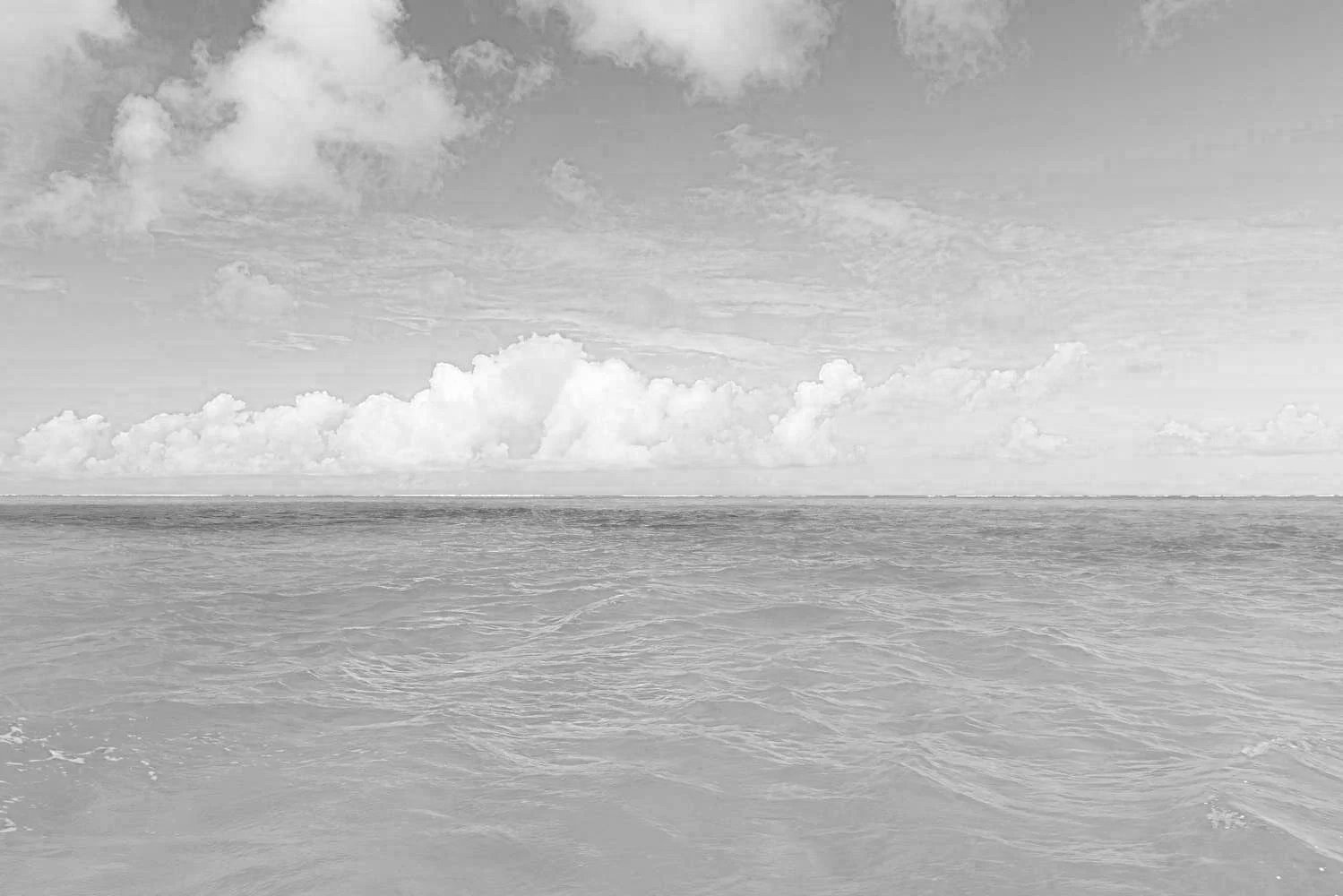
I cannot swim, nor will I ever learn. Instead, I stand and look out at the deep blue-green of the Mediterranean, which often makes me think of Paradise. It seems so warm and beautiful, as if all troubles will disappear if I stand and look at it. This is how I imagine Paradise, even though the Koran teaches us that there are angels in Paradise. For me, it’s a peaceful blue-green sea where Allah is the warm sun.
It’s not surprising that I think of this now as we drive along the coast. When a man is in danger but idle, he naturally turns his thoughts to the life after this sad life we live. The car goes around a curve, shoving me up against the door, as I look down for the hundredth time to check my machine gun, cradled on my left arm. It bounces against me as we hit a bump in the road. Bashir is driving very fast, and I wonder why. I’m certainly in no hurry. But what I want right now doesn’t matter. I’m here as a bodyguard, and driving is his concern, not mine. My concern, along with Adbul, sitting in the front playing with the radio, is to guard Fuad Yusuf, who sits beside me in the back. We hit another bump, and Fuad Yusuf says, ‘Damn it, Bashir, slow down!’
‘It’s better to be going fast when you hit a mine,’ Bashir says, and keeps driving fast. I don’t worry about mines. I’m certain that I’ll die soon, and a mine would be quick, but I’m nervous about ambushes. I don’t want to die slowly, with a bullet in me like a ball of brimstone. When we were getting ready to leave the city, one of Fuad Yusuf’s lieutenants made a last attempt to talk him out of going alone. Having a driver and two armed guards was the same as being alone, as far as he was concerned. Fuad Yusuf just kept on drinking his coffee, looking with his hard eyes at his lieutenant, then he calmly asked, ‘Would you like to go instead?’ Of course the lieutenant didn’t want to go. He’s not crazy and he doesn’t trust Bishara Janbalat’s men. Or even Bishara Janbalat. I also don’t trust Janbalat, and I suppose that Fuad Yusuf doesn’t entirely trust him, or I wouldn’t be here now, nervously rubbing my thumb over the handle of a machine gun and licking my lips from to time to moisten them.
As we come around a curve, Bashir has to slam on the brakes to avoid crashing through a flock of goats standing in the middle of the road. The car squeals to a stop and we all lurch forward. There are maybe twenty goats, brown and white creatures with bright eyes, but I think goats are stupid and they stink. An old woman, dressed all in black, even with a black shawl over her head, has a stick and is yelling at the goats. ‘Move! Move!’ She shouts and waves the stick in the air. Bashir gets out of the car to help her, but he’s lived all his life in the city. He doesn’t know a thing about goats, so he just stands and shouts and waves his arms, and when one of the goats with horns butts its head toward him, he jumps back toward the car, then stands with the door between him and the goat. In spite of the tension we’re under, or maybe because of it, Abdul starts laughing, then Fuad Yusuf laughs. I smile.
Finally, the old woman drives the goats off the road, some of them bleating and making noise. Bashir adds to the noise by blowing the car horn. In ten minutes we’re flying along again as if we hadn’t stopped. My stomach growls at me, a high gurgling noise so that Fuad Yusuf looks over at me, and I realize that I didn’t eat enough breakfast this morning. I wasn’t hungry then, but now I wish I had eaten more. My mother tried to get me to, but I only nibbled at the food, drank some coffee, and jumped up from the table. In general she’s a good cook, my mother, and seeing the goats I think of her delicious stewed goat with pilaf.
We’re passing a banana orchard and even a banana would be good to eat, but there’s nothing to do about eating now. I put food out of my mind, as I know it will be several hours at least until I can eat again. Unless Bishara Janbalat’s men serve us something, but I don’t expect it. This isn’t a social visit. Again I check my machine gun, which I’m holding to point toward the window on my left. The window is a little dirty. I look up at Abdul, who points his gun to the right. He’s again leaning over it, playing with the dial of the radio. He must have hundreds of cassette tapes at home, in Arabic, French and English. It would take him months to listen to them all, even once. Suddenly it seems ludicrous to me that a man like Abdul, who loves music so much, should be here. He should be at home, playing a new tape of some English band for us and eating pistachio nuts. But here he sits, holding a machine gun and going to a meeting with Bishara Janbalat. And why do I keep touching the trigger of this gun, ready to fire a bullet through a stranger’s heart? All over the world people are going to their jobs, or working in their fields. I might be working as a journalist somewhere, so what am I doing here? My gaze drifts out to the blue Mediterranean. Somewhere across the water, people aren’t shooting each other.
I think of the people I know and imagine them being killed. I shudder and glance over at Fuad Yusuf, whose father, mother, two brothers, three sisters, two brothers-in-law–I don’t even know how many of his family have been killed, and I remember why I’m riding along with a machine gun. We want to run our businesses and send our children to school, but if people come to kill us, what can we do? Should we lie down and die, one by one, until we’re all gone, or do we force ourselves to fight? People were scared and desperate until Fuad Yusuf organized us. Everyone I know trusts Fuad Yusuf. He can sit in the sun with old men and talk about the past, or squat down with children to talk about how hard it is to learn the shapes of letters in school. When my sister was sick once, during fighting, he sent two soldiers with a doctor to her. If I have to, I will die to protect Fuad Yusuf.
Then I think of the deaths that I’ve known. Houses had been bombed into piles of rubble. An old woman bent over from a heavy bundle was walking past them, far down the street, coming toward me. I heart a shot fired, and she fell forward. Only one shot, but it killed her. I also think about my brother, Rashid, who talked about going to Egypt or America, to study and become a doctor. Rashid never fought anyone, never held a gun in his life, but still they found his body on the beach.
Fuad Yusuf looks at his watch and says, ‘We’re going to be early. I told you you didn’t need to drive so fast.
‘But the mines,’ Bashir says.
‘If there are any mines, they’ll blow the goats up. Pull off by those trees ahead. I have to piss. Too much coffee this morning.’ Bashir pulls up near a group of small cedars, and we sit with the motor running while Fuad Yusuf goes off behind one of the trees. Abdul gets out and stands nearby. He looks ready to blast anything that might interfere with Fuad Yusuf taking a leak.
As they get back in, we see a woman come out of a group of trees on the other side of the road. ‘I hope she didn’t see me,’ Fuad Yusuf says. ‘She might fall in love with me.’ She comes out to the edge of the road now, standing opposite where I sit. I’m astonished by how beautiful she is, and I feel sad to drive away and leave her there. I turn around as we pull away, and watch her through the back window. Beautiful women always affect me this way. I stop breathing for a second, and then I feel shaking and strange inside. When I see such a woman, for a few seconds she’s the only thing in the world I want. I wonder sometimes why I even have a brain, if it stops working so easily. I also think it must be a sin, to want women so much. I try to remember what the Koran says about desiring women, but I can’t. It’s been a long time since I’ve read the Koran. I’ve even begun to wonder whether Allah exists. I don’t know anyone I can say this to, but how could anyone live my life and believe in Allah?
‘She was a pretty woman,’ Bashir says. ‘She looked like my cousin.’ I’ve never seen Bashir’s cousin, but it’s hard to imagine, since he’s so ugly. Abdul has the radio on a station with an old man talking. The old man reminds me of Kamal, from when I was a boy. I get the odd feeling that Kamal is on the radio, but I know he must be dead by now. Even back then he seemed as old as a stone. He used to tell us stories, whether they were true or not, of how he had once lived with the Bedouins, and rode around on a camel with them. He said the Bedouins ate balls of dried milk, and told us about ghosts and invisible things that lived in the desert. It was a lot of fun for city boys to hear stories about the desert. He also told us once about visiting Kurna, where the Garden of Eden used to be. Maybe it was Kamal’s stories that made me want to be a writer when I got older. I wrote one of his stories down one time and sent it to a magazine, but they didn’t print it.
‘Turn off the radio,’ Fuad Yusuf tells Abdul. The radio goes off, and suddenly the car fills up with silence. We’re getting close to Jounieh, and Fuad Yusuf looks very serious, or really there’s almost no expression on his face. Adbul takes his machine gun in both hands. I do the same. Bashir has slowed down. ‘We won’t start any trouble,’ Fuad Yusuf says. ‘We’re out of our own territory. But if they attack us, show them we don’t die like dogs. Bashir will try to get us away.’
We’re coming into the town of Jounieh now, and two cars are waiting for us, with Bishara Janbalat’s people. One car pulls out in front of us, one comes in behind. We follow the car in front through the town, then up into some hills, to a large house. A nice place, probably a businessman’s house. We stop in front of the house, but still don’t see Bishara Janbalat, which makes Fuad Yusuf nervous. We sit silently for a second, then he says, ‘May Allah in Heaven show His mercy.’ We get out of the car, Abdul and I clutching our machine guns, and as I step onto the ground I hear a loud staccato noise behind me. I whirl around, dropping the gun into firing position, as Janbalat’s men level their weapons at me, clicking them. A little boy, maybe five years old, runs between two of Janbalat’s men. He’s pointing a stick at me, loudly shouting ah! ah! ah! ah! in imitation of the machine gun that I’m pointing at his head. A man grabs the boy by the shoulder and shoves him roughly away. Guns are still pointing at us. A plan to kill us? My finger moves to the trigger. My stomach is tight. My mouth is dry. Is Paradise a deep blue-green sea?
About the Author
David Hutto’s work is forthcoming in Barely South Review and has recently appeared in the anthology Starved, as well as in Good Life Review, Galway Review, Avalon Literary Journal, Brussels Review, Paterson Literary Review, and other magazines. His experience includes writers’ retreats in Mérida, Mexico and Dublin, Ireland.