
Daylight
Ashley Mangtani (Fiction)
Arthur measured the candles on Sunday nights. He stood the week’s seven in a row on the dresser, pressed his thumbnail into each one, a notch for every evening, then locked the box away with the coal cellar key and hung the key on his watch chain. On Saturdays, he held the stubs up to the gas mantle and read them. Any candle burned past its notch went into the ledger. The ledger came out at supper, which was quiet. The quiet lasted into church.
On Fridays, he tipped his wage onto the table and counted it twice, slid the housekeeping across the wood, and entered the figure at the front of the book while the coins still held the warmth of his pocket. Then he turned the book to face her and set the pen on the line. Ruth signed for it, money hers to spend and never hers to keep.
She had written the letter by a wax-end saved from the back of the drawer, after the house slept, with the curtain pinned to its frame so no glow would cross the yard. The nib scratched louder than she liked. Twice she stopped and listened for the boards above her, for his weight crossing the room, and heard only the house breathing.
She cupped her hand close around the flame to keep it small. A bead of wax ran over her thumb and hardened under the nail. For five days, she carried both the letter buttoned inside her coat and the wax she could not work loose, her hand returning to the place on her ribs where the paper sat.
Monday came up brown. Fog had thickened in the night and hung now at the height of the lamp brackets, so the street kept clear to the knee and everything above the shopfronts blurred away. Ruth raked the range and put the kettle on its hook. Then she set Arthur’s breakfast down.
He had the morning paper folded to the coal prices. She caught the masthead on her way out.
The London Courier. Monday, 9 February 2026.
He turned a page as she shut the door, and that was the whole of his goodbye.
On the step she wound Tom’s scarf twice over his mouth, the red one she’d knitted last winter, and pushed his slate deeper into the satchel. The lamplighter worked back along the kerb toward them, reaching his pole into each lamp and pinching out the flame. Glass by glass, the gas died back into the brown.
‘Why’s he putting them out?’ Tom’s voice came through the wool.
‘You know why, Tom. You ask the same thing every day.’
‘It’s not light yet, though, Mum.’
‘Half seven is half seven. The gas company says the day’s started.’
‘What’s that mean?’
‘You’ll learn when you’re older.’
‘When I’m older, I could carry that pole.’
‘You could.’ She turned him by the shoulder and faced him up the street.
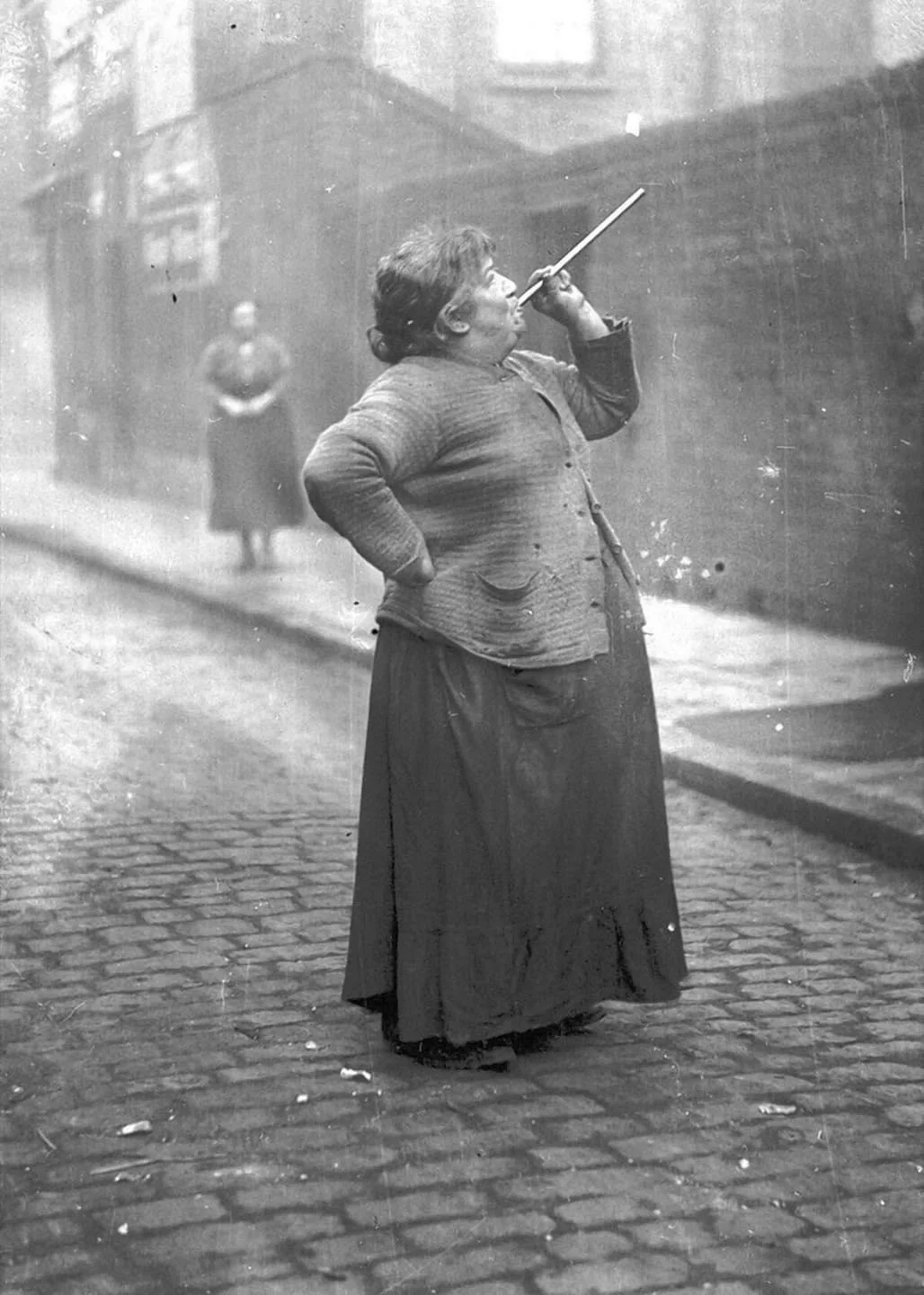
A woman came down Tanner’s Row with a long cane over her shoulder. At the third house she stopped, reached the cane up, and rattled its tip against a first-floor window until a hand showed behind the glass. Then she moved on to the next window.
‘Why does she knock the windows?’
‘To wake the people inside for work. They pay her a penny a week.’
‘Who knocks her window?’
‘Nobody. She wakes herself.’
He turned to watch her go, working it out.
The coalman’s cart stood outside the Wilsons’. Sacks went down through the hole in the pavement one after another, and every drop landed somewhere under the street with a sound Ruth could price to the penny.
At the fishmonger’s, the iceman swung a block off his cart in iron tongs and chalked what the business owed on the doorpost. Tom held his breath the whole length of the fish smell and let it out in a white burst, then read the marks as they walked, fours and sevens up one side of the street and down the other. The paperboy on the corner had his bundle on his hip.
‘Fog on the line! Northern mails delayed!’
Her hand went to her ribs. She bought no paper and walked on. At the iron grate outside the chemist’s, Tom stopped and planted his boots. The pavement trembled. Warm steam pushed up his trouser legs and lifted the scarf off his chin.
‘That’s the Baker Street train,’ he said.
‘How do you know?’
‘It shakes for ages.’ He stood on it until the train had passed, then took two running steps to catch her hand.
‘D'you think Aunt Maud'll send chocolates again?’
‘She might.’
‘I hope so. The soft ones were so good last year.’
‘She's a long way off, love, up in Leeds. But you'll see her soon enough. More chocolates, or something better.’
Her hand tightened on his before she could stop it, and he let it stay, busy with a dray horse on the far side. The Dispatch office on the High Road sent the city’s letters by air, through iron pipes laid under the streets. Inside, gas burned green-white down the length of the counter. Two dozen iron pipes rose out of the floor and curved over into wire baskets along the end wall.
As Tom pressed himself to the window, a canister shot into its basket with a felt-soft thud.
A girl in a grey pinafore had it up before it stopped rocking, read the address on its collar, and slotted it into the correct pipe. The wall exhaled behind her.
‘Make another come.’
‘They come when they come.’
Thud. A second canister. The girl's hands were already moving.
‘How does it know where to go?’
‘It doesn't. The operator reads the address and picks the pipe. The air does the rest.’
Tom watched her work. ‘You used to do that.’
‘Long time ago now.’
‘Why did you stop?’
She kept her eyes on the window. ‘The Dispatch doesn't keep wives.’
‘Why not?’
‘That's just how it is.’
‘That's not a reason.’
She looked at him then. ‘No,’ she said. ‘It isn't.’
He breathed a circle of fog onto the glass and rubbed it off with his sleeve. ‘Is it old?’
She nodded at the brass plate beside the doors.
LONDON PNEUMATIC DESPATCH. ESTABLISHED 1859.
‘Over a hundred and fifty years.’
‘That's before Grandad was even born.’
‘Before his grandad's grandad.’
She had stood six years on the other side of that counter. At fourteen, the Board school gave her a certificate with a red seal, and the Dispatch took her on at Holborn. By seventeen, she could route for three districts without looking at the wall charts. Best eye on the floor, the superintendent told her father, in front of the men.
Then Arthur Crane started sending coal. He was a foreman at the Beckton gasworks, and he had managed her mother's account for two years before Ruth ever put a face to the name. Every Friday, a hundredweight went down the cellar hole. Her mother's hands had gone at the mangle, the same mangle her grandmother had worked before her, and at the wedding breakfast she took Ruth’s wrist in those ruined hands and said what the street says of every man with extra coin. He keeps a good fire.
The day before, Ruth handed in her brass check at the workers' gate, and that was that. The rule ran the same in every trade she knew. A wife worked in her husband's house and nowhere else, and no court, no church, no company had ever seen a reason to change it. The superintendent saw her out himself and said the floor lost its best router every June, regular as the wedding season. That was twelve years ago. Something over six hundred Sundays of notches.
The candle marking had begun their first winter, the year coal ran short across London. Thrift, the street called it then. Arthur called it good management. Her mother called it being careful.
By the second winter, the candle box had a lock. By the third, Ruth never touched it again.
The collection key was already turning in the lock when Ruth reached the corner of the High Road. Her free hand went to her coat and undid the top button.
The chemist's boy was out with his broom. ‘Morning, Tom.’
‘Morning,’ Tom said, already past him.
Her hand did the button up again. The postman went by on her left, and Tom talked about trains the rest of the way, and she said yes in the right places.
There was no way to ask and no way to call it back. Once it dropped, it went at the speed of trains, and three days would pass before Maud could answer, three days in his house, at his table, under his candles, waiting for a word that might not come.
She had lain awake five nights running, and it ended the same way each time. Arthur had never once shouted. He would put on his church coat and take the ledger to the magistrate and read from it in his careful voice.
The candle waste.
The tea bought loose instead of by the chest.
Five pounds unaccounted for on the eighth of March.
A wage is a number a court can write down. Twelve years of washing and cooking and mending had no number at all. The magistrate would hear a careful man wronged by a careless woman, and the law would give that man his son. After the court came the church. Separated wives sat in the back pew. If they came at all.
What the ledger did not say was where the pounds went. They lay sewn into the hem of her Sunday coat, two years of Sundays, every gap he had left because it had never occurred to him that she could count.
She had done the sums on the margin of a flour bag.
Rent (Leeds, furnished) £18
Coal (quarter sack) £22
Lamp oil £14
Food (me + Tom) £18
⎯⎯⎯⎯⎯⎯⎯⎯⎯⎯⎯⎯
Out £72
my wage + Maud's £78
Over £6
Then she had burned the bag in the range and stirred the ash. Between her wage and Maud's, seventy-eight came in a week. Six over. Narrow, but over. She looked up. The wash-house on Friar's Lane was already in front of her.
Steam stood in the doors, and the Monday queue went down the steps, baskets on shoulders, sleeves rolled in the cold. Inside, the coppers boiled and the mangles turned.
High on the wall, a bill had yellowed to the colour of the steam.
VOTES FOR WOMEN
In letters a foot tall, above a meeting date nobody could read any more.
Mrs Finn wrung a sheet in the doorway, her voice carrying across the queue. ‘Mrs Cole’s washing for strangers in Hoxton now. Eight months since the magistrate.’ Her eyes crossed Ruth’s and held half a second longer than they needed to. ‘He kept the boys, the house, and the piano.’
A voice back in the steam said the piano had been her mother’s. At the foot of the steps, a young woman held out a letter. Mrs Finn wiped her palms on her apron and read it aloud, a son writing from lodgings, money sent, and a date he’d be home for Christmas, while the woman watched the page and could not follow a word. Ruth pulled her gloves tighter. Her knuckles were turning into her mother's. Under her right thumbnail, the wax sat where it had set, five days ago.
The school on Chandler Street rang the children in at nine. The master's boy stood under the bell arch with the rope wrapped twice round his fist, and mothers crowded the gate, holding on until the last possible moment. Mrs Finn's girl was going into service at Whitsun. Eleven years old, a good place out at Richmond. Her mother had said it three times already this morning. The Hobbs boy would start at the gasworks the day he turned twelve. Coal had gone up a penny a hundredweight.
Across the road, against the railings of the chapel, Mrs Cole stood in last winter’s coat with her hands folded in front of her.
Tom pulled his scarf down to his chin. ‘Why does Mrs Cole stand over there?’
‘She’s seeing her boys in.’
‘From across the road?’
‘From where they'll let her.’
He filed it with the fog. ‘Father's showing me the candle marks on Sunday. He says a careful house can tell where every penny goes.’
The wool had printed a red line across his cheek. Ruth crouched and tucked the scarf end down into his coat, and she took her time with it. ‘Learn your letters first.’
‘I know my letters.’
‘Learn them better.’
He dug into his trouser pocket and brought out an old platform ticket, soft at the corners from a week in his pocket, and posted it into the cuff of her glove. ‘Keep it safe.’
She pressed her lips to his forehead. ‘I love you, Tom.’
The bell swung over their heads, and he ran with the rest.
Two boys stood in the lines by the drainpipe, a tall one and a small one with matching haircuts, and the tall one turned his head toward the chapel railings and turned it back. Across the road, Mrs Cole raised her hand and held it there until the lines moved. Then the cloakroom door took the children in, and the yard emptied to its hopscotch chalk going grey in the damp.
A crossing sweeper had brushed a clean lane through the horse mess at the corner. Ruth crossed by it and came to the railings an arm's length from Mrs Cole. For a while, neither woman spoke. Both faced the empty yard.
‘The two by the drainpipe were mine,’ Mrs Cole said. ‘They’ve had their hair cut.’
‘Tom’s third row. Red scarf.
A milk dray went past behind them, churns ringing against each other.
‘I went ahead to find a room,’ Mrs Cole said. ‘Three weeks, that was all. The magistrate called it desertion. He got the house. He got the boys. And I came home to a locked door.’
The master’s boy looped his rope and went inside.
‘I'm going to my sister,’ Ruth said. She had never said it aloud before. ‘Leeds. Friday.’
‘Tom as well?’
‘Tom as well.’
‘Hold his hand from your doorstep to her door. Don't put the bag down. Don't go back for anything.’ She looked at Ruth. ‘They forgot me the minute I left.’
Ruth walked back up the High Road with her hand inside her coat. The post box stood on the corner. The collection plate said the next post went at eleven.
She had addressed it in her sorting hand, the letters tall and plain, the way she'd written addresses on a thousand canisters at Holborn.
Miss M. Hartley, 14 Bridge End, Leeds 2.
Maud had written in October. Ruth knew it by heart.
Bring him. The bindery asks no questions of a woman who can stitch a spine straight, and my room holds two beds.
Two letters had gone into the range before this one—the first asked permission. The second apologised. The one in her hand said Friday.
Friday, then. The half past nine from King's Cross, a cold pie on her lap, while Arthur stood at the retorts all day with no reason to think she'd gone. One bag. She had packed it twice in her head and not yet once in the world. The certificate with the red seal at the bottom, under Tom's jersey and his tin of tickets. They would walk to the station and spend nothing getting there.
She had carried the map of this city in her head since Holborn, every shortcut and back lane between her door and the platforms, a map she had only ever used to send other people's words across the city. On Friday, she would follow it herself. Tom would name every train they passed by the sound of it, the whole way north, and she would let him.
The iron flap dragged on its hinge and bit cold through her glove. She held the letter half in the mouth of the box.
Fog on the line. The mail’s delayed.
She opened her fingers. A small sound, far down. Paper finding paper. Her right glove had gone loose at the thumb, and when she drew it off, the wax came with it, the bead she'd carried five days, and she flicked it into the gutter and let it go.
Down the street the fog was thinning off the river. The sun came through over the gasworks chimney, a pale coin, then a coin rubbed bright, and the light reached her where she stood. Nobody had lit it. Nobody had locked it in a box, or notched it, or written it down in a ledger. No company owned it, and no clock told it when to start. It fell on the post box and the chapel railings and the horse mess and on her, the same light on all of it, and not a penny to pay.
She turned her face up. The cold went out of her hands first, then her cheeks. She stood in it until she'd had enough, then put her glove back on and started home, past the wash-house steam and the dead lamps and the pipes swallowing the city's words, with Tom's ticket riding in her glove.
By Friday night, the house would hold a locked box of light, a ledger squared to the penny, and a dinner going cold under its plate. And no one to cook the next one, and no boy asleep upstairs.
On Sunday, Arthur would set out seven fresh candles, notch them, and lock the box.
Let him.
About the Author
Ashley Mangtani is a slipstream writer whose work explores ecological and social collapse, and the roles people inhabit in moments of crisis. His work appears or is forthcoming in Smokelong Quarterly, Strange Horizons, Litro, Washington Square Review, Boudin, BULL, Expat Press, Thin Skin, HAWKEYE, Mobius, Neon Dystopia, Apocalypse Confidential, and others. Read more at ashleymangtani.com.